
Sustainability
Startseite » Company » Sustainability
- Sustainability starts with the right technology
Responsibility with a system
As a specialist in busbar trunking systems, ABH develops solutions that distribute energy efficiently and reliably for decades. Sustainability is not a side issue, it is an integral part of our technical and business decisions.
Our responsibility for the environment, resources, and future generations is reflected in product development, our supply chain, manufacturing, and our day-to-day actions. As part of the Addtech Group, we are committed to responsible business practices based on a binding Code of Conduct.
- Less material and energy loss
Resource-efficient busbar systems
Our modular busbar trunking systems make a significant contribution to reducing material and energy losses. In particular, the EMC-optimized KX series reduces magnetic fields by up to 90% and improves operational safety. An advantage especially in sensitive environments such as hospitals, airports, data centers, or administrative buildings.
Through continuous product optimization and digital planning processes such as BIM and CAD, we reduce material waste and installation effort. This enables us to make a verifiable contribution to meeting environmental standards in the construction industry.
- Responsibility & Code of Conduct
Sustainability within the company
Our commitment doesn’t end with the product. In our own manufacturing, we also focus on efficiency, durability, and recyclability. We likewise expect our suppliers to comply with ethical, environmental, and social standards in line with our Code of Conduct.
For us, sustainability also means acting ethically. The Addtech Group’s Code of Conduct commits us to transparency, equal treatment, and integrity in all areas- from employee training to product responsibility.
To implement our environmental goals systematically, we have established a dedicated Sustainability project team. This interdisciplinary team develops concrete measures to conserve resources, supports their implementation across departments, and ensures that sustainability at ABH is not an empty phrase, but a lived practice with measurable results. You can reach our Sustainability team at Sustainability@abh-stromschienen.de.
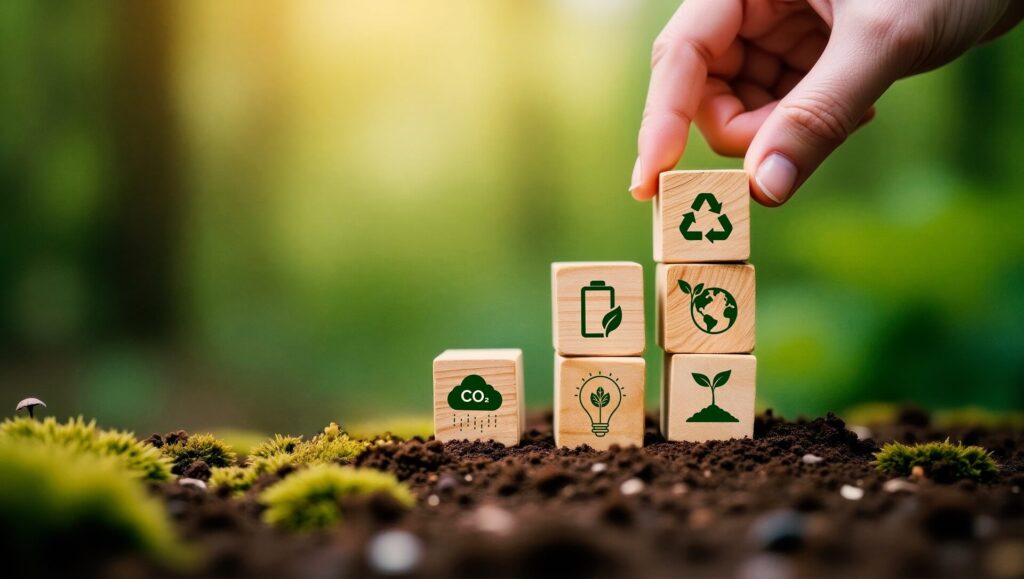
- Meeting environmental standards, reliably delivered
Sustainable reference projects
Our modular busbar trunking systems are used in numerous projects with high environmental standards. Browse our reference projects and see for yourself!
- Our goals for 2030 – a roadmap for sustainable development
Strategy, targets, and outlook
At ABH, we pursue concrete and measurable sustainability goals that guide us over the long term. In line with the Addtech Group’s sustainability strategy, we focus on three key fields of action: technology & the environment, social responsibility, and economic viability.
A partnership-based collaboration with customers, planners, suppliers, and other stakeholders is crucial for us to make progress toward our sustainability goals by 2030, while also contributing to tackling global challenges.
We see sustainability as a dynamic process: we continuously analyze risks and opportunities in the areas of environment and responsibility in order to further develop our products and business models in a future-proof way.
- Responsibility & Code of Conduct
Supporting global sustainability initiatives
ABH aligns itself with the international sustainability goals (UN Agenda 2030). These global goals are an integral part of our assessment—of both our positive and our negative impacts on sustainable development.
Goals we have successfully supported so far
Ensure access to affordable, reliable, sustainable, and modern energy for all.
We support this UN goal with our busbar trunking systems, which offer higher efficiency than cables, in projects involving, for example, energy storage systems or the expansion of EV charging infrastructure.
Build resilient infrastructure, promote inclusive and sustainable industrialization, and foster innovation.
Our busbar trunking systems reduce raw material requirements compared to cable systems.
Thanks to click-and-play functionality, the system can be expanded without the need for new installations. In addition, our systems deliver higher efficiency-making industrial processes more sustainable.
In construction projects such as data centers, university buildings, or facilities that help ensure food supply, we also contribute to achieving this overarching goal.
Ensure healthy lives and promote well-being for all at all ages.
The artificially generated electromagnetic fields (EMF) of our busbars are 90% lower than those of other busbar trunking systems, and they are characterized by high short-circuit strength and operational reliability.
We are also active in areas such as hospital construction and, more broadly, in projects that support healthcare and preventive medicine.
Areas with potential negative impacts & our responsible approach
Take urgent action to combat climate change and its impacts.
We also recognize that our logistics- and transport-related carbon footprint (Scope 3) is relevant, and we are actively working to minimize it.
Promote sustained, inclusive, and sustainable economic growth, productive employment, and decent work for all.
Negative impacts can arise in complex value chains. That is why we rely on transparent supply chains and fair, sustainable standards.
We ensure this through our Code of Conduct.
- Science Based Targets
Climate targets for ABH
As part of the Addtech Group, ABH Stromschienen pursues a long-term climate strategy aligned with the requirements of the international Science Based Targets initiative (SBTi). Since May 2024, Addtech’s climate targets have been officially validated by the SBTi. This commits us to measurable, science-based actions to reduce our greenhouse gas emissions across the entire value chain.
Our overarching goal: Net Zero by 2050
ABH supports the Group-wide goal of achieving net-zero emissions across all scopes by no later than 2050-from production and supply chains to the use of our products.
Short-term targets by 2030
- Reduce absolute Scope 1 and Scope 2 emissions by 50% by 2030 (base year: 2022).
- By 2028, 30% of our suppliers (measured by purchasing volume) will have implemented their own science-based targets.
- At the same time, we aim for 10% of our customers (based on revenue and the use of our products) to pursue science-based targets by 2028 as well.
Long-term targets by 2050
- Reduce Scope 1 and Scope 2 emissions by 95% by 2050.
- Reduce Scope 3 emissions (e.g., from supply chains, transport, or product use) by 90% over the same period (base year: 2022).
- Get in touch
Contact and further information
Do you have a question about our sustainability strategy? Contact our Sustainability team and follow us on LinkedIn so you don’t miss any updates.

